A graphene coating is an advanced liquid polymer infused with graphene molecules typically graphene reduced oxide, that bonds chemically with a vehicle’s clear coat. By combining traditional premium ceramic technology (like Silicon Dioxide) with the structural strength of graphene, it creates an ultra-slick, highly heat-resistant barrier. This advanced coating technology shields automotive paint from UV rays, environmental pollutants, chemical stains, and water spots far more effectively than traditional waxes or standalone ceramic coatings.
Vehicle paint protection technology has evolved rapidly over the past decade. If you are looking to safeguard your investment against harsh environmental hazards—from the blazing UV exposure of the UAE and Australia to the daily road contamination in the USA, India, and Germany, you have likely encountered advanced coating technology.
While traditional paint protection options served their purpose, a newer milestone in surface science has emerged: graphene coating.
This guide breaks down the science behind nano graphene coating, explains how it works on an atomic level, and highlights why it is setting a new benchmark for premium automotive surface protection.
Key Takeaways
Unmatched Material Strength: Graphene is a single layer of carbon atoms arranged in a honeycomb lattice, making it one of the thinnest yet strongest materials known to science.
Superior Thermal Properties: High thermal conductivity dissipates heat, significantly lowering the surface temperature of the paint and drastically reducing the formation of hard water spots.
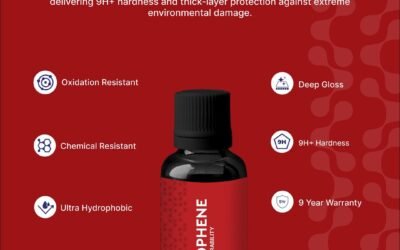
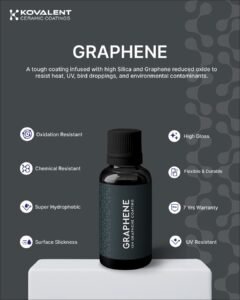
Extended Longevity: While standard ceramic coatings offer robust protection, premium formulations like Kovalent Coatings Graphene deliver enhanced flexibility and up to 7 years of warranted durability.
The Self-Healing Frontier: Next-generation advancements, such as Kovalent Graphene Matrix, utilize nanotech that activates under ambient heat to instantly self-heal minor swirl marks and micro-scratches.
What Is Graphene Coating?
An automotive graphene coating is not just raw carbon poured over a car; it is an evolution of nanoceramic technology.
Pure ceramic coatings rely primarily on Silicon Dioxide and Silicon Carbide to form a glassy protective layer. A premium graphene coating takes this established Graphene Matrix and infuses it with graphene reduced oxide (rGO).
The inclusion of rGO modifies the chemical matrix. It enhances the overall tensile strength, increases flexibility, and lowers the friction coefficient of the cured surface. This creates a hyper-slick, automotive surface protection layer that shields a vehicle’s paint from daily degradation while adding an incredibly deep, reflective gloss.
What Is Graphene?
To appreciate why this technology is revolutionary, it helps to look at the raw material. Discovered in 2004, graphene is a two-dimensional allotrope of carbon.
It is exactly one atom thick.
On a molecular scale, it is roughly 200 times stronger than steel.
It is highly flexible, an excellent conductor of electricity and heat, and completely impermeable to gases.
By integrating these specialized atomic structures into a liquid nanotechnology carrier, engineers have successfully translated these molecular advantages into real-world vehicle paint protection.
How Does Graphene Coating Work?
When a professional graphene coating is applied to a clean, polished vehicle paint surface, a cross-linking chemical reaction occurs.
Chemical Adhesion: The carrier solvents evaporate during application, forcing the Silicon dioxide and nano graphene particles to anchor directly into the microscopic pores of the clear coat.
Lattice Formation: As it cures, the graphene particles organize into an incredibly tight, interconnected molecular web.
Sacrificial Barrier: This thin web forms a permanent bond that seals the paintwork. Because the pores of the clear coat are completely blocked, contaminants like environmental pollutants, acidic bird droppings, road salts, and bug sap cannot physically penetrate or corrode the underlying paint layer.
Main Benefits of Graphene Coating
Hydrophobic Performance Explained
One of the most satisfying features of a premium graphene coating is its extreme hydrophobic behavior (water repellency). Graphene coatings create an exceptionally high water contact angle, often exceeding often exceeding 110° to 115°.
Because the surface is incredibly slick on a nano-scale, moisture cannot easily grip the panel. Instead, water instantly beads into tight spheres and rolls away cleanly, pulling surface dirt and light dust off with it, a phenomenon known as the self-cleaning effect.
Heat Resistance and Thermal Properties
Automotive paint undergoes extreme stress in hot climates. High UV exposure breaks down clear coats over time, causing oxidation and paint fading.
Graphene possesses an exceptionally high rate of thermal conductivity. Instead of absorbing and trapping heat on localized areas of the bodywork, a graphene technology coating effectively dissipates heat across the entire panel. This prevents localized heat buildup, slowing down chemical degradation and providing superior resistance against UV damage.
Does Graphene Coating Reduce Water Spots?
Yes, and this is a primary reason professional detailers choose graphene coatings over traditional coatings.
Traditional ceramic coatings are notoriously prone to etching from hard water spots. Because ceramics retain heat, water droplets sitting on a hot hood evaporate rapidly, leaving behind concentrated mineral deposits (calcium and magnesium) that bake into the coating.
Because graphene sheds heat and features a lower surface friction design, water slides off before it can dry completely. If droplets do evaporate, the lower surface temperature minimizes the chemical baking process, making mineral deposits significantly easier to wipe away without etching the paint.
Graphene Coating vs Ceramic Coating
While both options offer excellent automotive surface protection, comparing a professional graphene coating to a traditional ceramic coating reveals distinct structural advantages:
| Feature | Graphene Coating | Traditional Ceramic Coating |
| Heat Resistance | Higher (Excellent Thermal Dissipation) | High |
| Water Spot Resistance | Better (Due to lower surface temperature) | Good (Prone to mineral etching) |
| Hydrophobic Performance | Excellent (110°+ Contact Angle) | Excellent |
| Surface Slickness | Higher (Extremely low friction) | High |
| Gloss Enhancement | Excellent (Rich, deep reflection) | Excellent (Glass-like shine) |
| UV Protection | Strong (Defends against oxidation) | Strong |
| Durability & Flexibility | Very High (Up to 7–9 Years) | High (Typically 2–5 Years) |
How Long Does Graphene Coating Last?
The lifespan of your paint protection depends largely on the quality of the product and how it is maintained.
A retail-grade, DIY graphene spray coating might offer protection anywhere from 6 to 12 months. However, a professional-grade product—like the flagship solutions manufactured by Kovalent Coatings—is designed to form a permanent bond.
Backed by rigorous real-world testing (including accelerated weathering and salt-spray cycles), a professional nano graphene application safely delivers 7 to 9 years of robust durability, depending on whether you opt for a standard reinforced matrix or an advanced self-healing formula.
Where Can Graphene Coating Be Applied?
Advanced paint protection technology is highly versatile. It is not limited strictly to external car paint; a professional application can protect multiple surfaces across a vehicle:
Exterior Paintwork: Preserves gloss and stops clear coat oxidation.
Wheels and Brake Calipers: Resists high heat and repels corrosive metallic brake dust.
Glass Surfaces: Enhances wet-weather visibility by forcing rain to clear off rapidly.
Trim and Plastics: Prevents fading, chalking, and graying caused by UV exposure.
Why Professional Application Matters
While the prospect of applying a coating yourself may be tempting, achieving maximum durability and performance requires an expert hand. Graphene coatings are highly concentrated chemical formulas with precise cure windows.
Surface Correction is Mandatory: Any swirl marks, deep scratches, or oxidation left on the paint will be permanently locked underneath the crystal-clear coating. Professional detailers spend hours performing precision paint correction beforehand to ensure a flawless finish.
High Spots and Flashing: If a coating is left to cure too long before being leveled out, it creates dark, cloudy patches known as “high spots.” These cannot be washed off; they must be mechanically polished away, destroying the coating in that area.
Controlled Curing Environments: Industrial coatings require optimal humidity levels and controlled ambient environments to flash properly, ensuring the structural stability of the final matrix.
The Future of Automotive Surface Protection
The boundaries of surface science continue to expand. While graphene has set a phenomenal benchmark, modern material engineering is already introducing complementary technologies. Forward-thinking manufacturers are now exploring alternatives like Borophene Coating (utilizing advanced Boron Nitride nanotech) alongside graphene matrix systems to push hardness, slickness, and gloss boundaries even further.
A Note on Real-World Expectations: It is crucial to dispel common industry myths. No premium coating is completely “scratch-proof,” permanent without proper maintenance, or entirely maintenance-free. What it will do is drastically reduce your wash time, minimize daily wear and tear, and preserve a factory-level showroom shine for years to come.
Frequently Asked Questions
Is graphene coating worth it?
Yes. For owners looking for maximum longevity, heightened resistance to hard water spots, and a hyper-slick surface that minimizes wash marring, upgrading to a graphene-infused system offers a clear performance yield over traditional ceramics.
Can graphene coating be applied to new cars?
Absolutely. Coating a new car immediately is highly recommended, as the clear coat is pristine and requires minimal paint correction, preserving the flawless factory finish from day one.
Is graphene coating suitable for hot climates?
Yes. Thanks to its inherent high thermal conductivity, graphene coatings are uniquely qualified for hot regions (like the UAE or parts of Australia and India) because they effectively dissipate localized panel heat and resist severe UV degradation.
What is the difference between Kovalent Graphene and Graphene Matrix?
The standard Kovalent Graphene coating focuses on extreme 10H tensile hardness, chemical resistance, and a 7-year lifespan. The advanced Graphene Matrix includes specialized elastomeric properties that allow the surface to instantly self-heal minor swirl marks when exposed to heat (100°C).
For an insider perspective on how professional detailing teams execute these high-performance applications, watch this comprehensive walkthrough on How to Apply Kovalent Coatings. This video provides helpful tips on clean-room preparation and handling advanced nanoceramic formulas to guarantee an optimal bond.