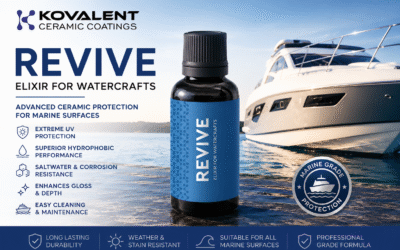
Saltwater environments present a massive challenge for boat owners. The combination of intense ultraviolet rays, abrasive salt crystals, and marine growth constantly attacks your boat hull. If you sail through rough coastal waters like the Gold Coast or park your vessel near busy docks in Sydney Harbour, you need premium surface protection.
For decades, boaters relied exclusively on traditional marine wax. Today, advanced nanotechnology brings graphene matrix and nano ceramic formulas to the forefront of marine detailing.
Understanding Traditional Boat Wax
Boaters typically make traditional wax from natural carnauba or synthetic polymers. Wax sits on top of the gelcoat rather than bonding deeply into the pores. It provides a temporary glossy finish and short-term water repellency.
However, saltwater degrades traditional wax quickly. The harsh salt environment and hot sun break down the wax layer within a few weeks or months. This forces boat owners to reapply wax multiple times throughout a single boating season to prevent heavy oxidation.
The Power of Graphene Matrix and Ceramic Nanotechnology
Graphene coatings utilise an advanced matrix of carbon atoms arranged in a honeycomb layer. When manufacturers combine this technology with silica nanoparticles, the solution creates an incredibly durable shield.
Products like Kovalent Coatings Revive use pure silica nanoparticles ranging from 20 to 50 nanometers. The smaller particles fill the microscopic pores of the fibreglass gelcoat. The larger particles form an ultra-hard crystal layer over the top surface. This process creates a covalent bond that locks into the boat hull, ensuring the protective layer does not wash away.
Head-to-Head Comparison in Saltwater
1. Saltwater Resistance and Corrosion Shielding
Saltwater naturally carries corrosive properties that etch bare gelcoat. Traditional wax offers basic water sheeting but breaks down when salt crystals dry and bake on the hull. Graphene matrix options provide extreme chemical resistance. The slick, hydrophobic surface prevents salt from forming a tight bond, which allows you to rinse away salt spray with fresh water alone.
2. Longevity and Maintenance
A quality marine wax lasts about two to three months in harsh saltwater conditions before losing its protective qualities. Advanced options from Kovalent Coatings endure the toughest marine environments for multiple seasons. This durability eliminates the endless cycle of stripping and rewaxing your boat every few months.
3. Fighting Biofouling and Algae
Algae, barnacles, and marine grime easily grip onto the soft surface of traditional wax. Graphene and ceramic systems create an ultra-smooth surface. This slick finish reduces drag in the water, improves fuel efficiency, and stops marine organisms from anchoring firmly to your vessel.
Conclusion
Graphene matrix and advanced nano ceramic technology easily win the battle against traditional wax in saltwater environments. While wax offers a lower initial price, it requires immense labour and frequent reapplication. Investing in advanced coatings keeps your boat looking pristine while saving you dozens of hours of maintenance time.
Frequently Asked Questions
Does saltwater destroy boat wax?
Yes. High concentrations of sodium chloride ions break down the weak topical bond of organic or synthetic wax, completely stripping the layer within 4 to 6 weeks.
Why is graphene coating better than wax for a saltwater boat?
Graphene forms a permanent covalent bond that cannot wash off or melt, while its high thermal conductivity prevents the salt crust from baking onto the hull.
How long does graphene coating last on a boat hull in saltwater?
A professional-grade graphene coating delivers durable protection that lasts up to 2 to 3 seasons below the waterline and up to 5 years on upper gelcoat structures.
Does graphene coating stop barnacles from sticking to a boat?
Graphene’s hyper-slick surface structure drastically lowers surface energy, making it incredibly difficult for marine organisms to form a strong attachment, allowing easy release during rinsing.
How can professional detailing shops buy Kovalent Graphene coatings?
Approved professionals can register a trade enquiry through our online portal to purchase factory-direct coatings and supplies directly from our global manufacturing network.