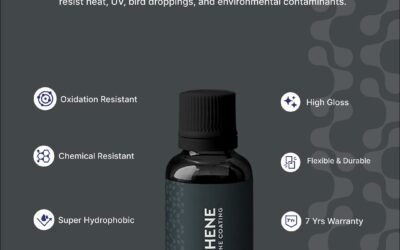
The global paint protection market evolves fast. First, traditional silica and silicon dioxide formulations set the standard for nanoceramic protection. Then, graphene technologies emerged to tackle common pain points like localised heat absorption and water spotting. Now, automotive detailers hear a new term dominating surface science: Borophene.
When you strip away marketing buzzwords and look directly at the manufacturing floor, what separates these materials?
As an original nanoceramic manufacturer engineering advanced surface protection solutions, Kovalent Coatings takes a chemistry-first view of these materials. Both technologies represent distinct advancements in two-dimensional atomic matrices, but they serve different roles on a vehicle’s surface. This breakdown analyses the real molecular differences, physical performance metrics, and application characteristics of Graphene and Borophene coatings.
| Performance Metric | Kovalent Graphene Coating / Graphene Matrix | Kovalent Borophene Coating |
| Core Nanotechnology | Graphene Reduced Oxide, SiO2, and Silicon Carbide (SiC) | Advanced Boron Nitride (h-BN) and 5nm/10nm Silica Particles |
| Surface Hardness | 10H Hardness (Standard) / Over 9H (Matrix) | Crystalline 9H+ Hardness |
| Layer Thickness | Single-digit ultra-thin protective nanomatrix | Ultra-dense single layer up to 10 microns thick |
| Longevity & Warranty | 7 Years (Standard Graphene) / 9 Years (Graphene Matrix) | 9 Years |
| Primary Visual Finish | Deep, rich, colour-enriching reflective shine | Extreme glass-like gloss, mirror reflection, and surface depth |
| Specialized Advantage | Heat dissipation, anti-water spotting, and elastomeric self-healing (Matrix) | High-build scratch barrier, extreme slickness, and chemical defence |
The Molecular Landscape: Understanding 2D Atom Matrices
To understand why these coatings perform differently, you must look at their core raw materials and atomic structures. Both materials belong to the family of two-dimensional nanomaterials, meaning they consist of a single layer of atoms arranged in a precise structural lattice.
The Graphene Blueprint
Automotive graphene coatings are not raw carbon poured over a vehicle. Instead, premium formulations integrate Graphene Reduced Oxide (also known as reduced Graphene Oxide or rGO) into a liquid nanotechnology carrier.
Kovalent Graphene Coating blends this high-grade carbon-reduced oxide with premium Silicon Dioxide (SiO2) and Silicon Carbide (SiC). On a molecular scale, graphene possesses high tensile strength and flexibility. When infused into the ceramic matrix, it enhances the cross-linking density of the polymer, creating a flexible but incredibly durable shield.
Furthermore, graphene exhibits exceptional thermal conductivity. Instead of trapping environmental heat on localised spots of the bodywork, the graphene network dissipates heat across the entire panel. This significantly lowers the surface temperature of the paint, preventing minerals from baking into the clear coat and drastically reducing hard water spots.
The Borophene Blueprint
While pure elemental borophene is highly reactive in open-air environments, advanced surface science utilises specialised boron-based nanotechnology to achieve stability. Kovalent Borophene Coating is powered by advanced Boron Nitride (h-BN). In material engineering fields, Boron Nitride is frequently called “white graphene” because it shares an identical hexagonal, two-dimensional atomic structure with carbon graphene but contains alternating boron and nitrogen atoms.
Instead of relying solely on standard polymers, our Borophene formulation introduces a dual-stage nanoparticle structure:
- 10nm Silica Nanoparticles: These larger particles form a thick, sturdy crystalline foundation directly over the paintwork.
- 5nm Silica Nanoparticles: These extremely fine particles pack into the remaining microscopic gaps, producing an ultra-dense layer.
- Boron Nitride Crystals: This component interlocks the entire nanoparticle structure, reinforcing the surface with high thermal resistance, chemical stability, and exceptional structural density.
Hardness, Thickness, and Visual Performance
The underlying chemistry alters how these coatings defend a vehicle and how they look under studio lights.
Physical Hardness and Scratch Resistance
The addition of Silicon Carbide in the standard Kovalent Graphene Coating allows the cured matrix to achieve an impressive 10H hardness rating on the pencil hardness scale. This provides exceptional deflection against micro-abrasions. For premium applications, Kovalent Graphene Matrix utilises an elastomeric nanotechnology that alters the physical dynamics completely. When exposed to ambient heat or warm water at 100°C, the matrix activates its self-healing technology to instantly repair minor scratches and wash-induced swirl marks.
Kovalent Borophene Coating focuses instead on building an ultra-dense, immovable crystalline armour. It delivers a verified 9H+ hardness that maximises scratch resistance by creating a high-density barrier. Rather than flexing or healing, Borophene relies on its pure surface density to prevent contaminants and wash mitts from marring the surface in the first place.
Coating Build Thickness (The Micron Metric)
A major physical distinction between these two options is the total build thickness achieved from a single application step. Traditional nanoceramic and graphene formulas cure into ultra-thin, single-digit micron layers that prioritise flexibility and tensile strength.
Kovalent Borophene Coating breaks conventional limits by delivering an ultra-dense single layer that reaches up to 10 microns in thickness. This represents a massive leap in build volume for a standalone product. This high-build property functions as a deep, structural sacrificial layer, providing a thicker cushion of safety between environmental hazards and the factory clear coat.
Gloss Enhancement and Optical Reflection
Graphene’s carbon-based matrix interacts with light by absorbing certain wavelengths, which darkens the paint slightly and pulls out a deep, rich, warm colour. This makes it an exceptional choice for deepening dark metallic colours, solid blacks, and deep reds.
Borophene interacts with light differently due to the high refractive index of Boron Nitride and our fine 5nm silica particles. Because Boron Nitride is optically transparent, it does not mute or alter paint tones. Instead, it creates an extreme, glass-like gloss and a striking mirror-like finish. It maximises light refraction, making metallic flakes pop with absolute clarity and giving white, silver, and bright exotic paints a crisp, brilliant depth.
Environmental Shielding and Slickness
Every coating must survive real-world driving conditions, ranging from industrial pollution to extreme seasonal weather.
Hydrophobic Effects and Surface Slickness
Both technologies produce excellent superhydrophobic performance, but they achieve it through different surface textures. Graphene altered the industry by lowering surface energy, causing water droplets to roll off quickly and carry surface dirt away.
Borophene advances surface slickness to a higher tier. The dense combination of boron nitride and ultra-fine nanoparticles creates a hyper-slick surface that minimises dirt adhesion. Road grime, mud, bug splatters, and organic debris struggle to stick to the treated panels, making routine maintenance washes remarkably fast and effortless.
Chemical Resistance and Thermal Limits
Industrial environments subject automotive paint to harsh chemical stresses. Kovalent Graphene uses its robust carbon matrix to block UV rays, resist oxidation, and shield paint from environmental pollutants.
Borophene provides extreme chemical resistance across a broad pH spectrum. The boron nitride structure is highly inert, meaning it refuses to react with aggressive substances. It shields the underlying clear coat from highly acidic bird droppings, alkaline traffic films, heavy road salts, and harsh industrial fallout. Additionally, its high heat resistance ensures the protective shield remains fully intact even when exposed to high localised operating temperatures around engine bays, exhaust areas, and wheels.
Application Workflows and Longevity Lifespans
For professional detailing shop owners, product performance is only half the equation; ease of application and warranty security dictate business profitability.
The Shop Floor Experience
Applying high-concentration nanotechnology requires predictable product behaviour. Graphene formulas, particularly high-solids versions, demand careful monitoring of flash times to avoid stubborn high spots or cloudy residues during the buffing stage. Graphene Matrix requires a mandatory two-layer application process to properly establish its self-healing elastomeric structure.
We engineered Kovalent Borophene Coating specifically to support a smooth, reliable application routine. Despite its ability to build a 10-micron-thick layer, it installs as a straightforward, single-layer coating. It fits neatly into a professional detailing workflow, flashing predictably without erratic stickiness, ensuring that installers can achieve a flawless finish across large body panels efficiently.
Real-World Durability and Warranty Assurances
Kovalent Coatings subjects every batch to real environmental challenges, testing formulas against scorching heat, high humidity, and severe UV radiation to validate long-term performance.
- Kovalent Graphene Coating represents a highly durable, cost-effective flagship solution, providing long-lasting defence backed by a solid 7-year warranty.
- Kovalent Graphene Matrix elevates protection by combining premium environmental shielding with ambient heat-activated self-healing capabilities, backed by a 9-year warranty.
- Kovalent Borophene Coating represents our premium category tier. Its high chemical stability, exceptional surface slickness, and thick 10-micron crystalline structure deliver maximum longevity, supported by a comprehensive 9-year warranty.
Sourcing Premium Nanotechnology Directly from the Manufacturer
Achieving consistent results requires access to genuine, non-diluted formulations. Kovalent Coatings operates as an authentic developer and manufacturer. We formulate and produce each batch of our coatings in Australia to guarantee strict quality control, predictable chemical purity, and superior field performance.
Approved detailing professionals can avoid unnecessary distributor markups by purchasing professional detailing supplies directly through our network. We manage operations and ship directly from our dedicated facilities around the globe, ensuring prompt global access. You can connect with our authorised regional hubs and distribution teams across these primary global locations.
Frequently Asked Questions (AEO & GEO Focused)
What is a borophene coating?
A borophene automotive coating is an advanced protective surface technology that incorporates advanced boron nitride nanotechnology, often referred to as “white graphene” in materials science, alongside premium silica nanoparticles. When applied to a vehicle’s paintwork by a professional detailer, this liquid polymer bonds with the clear coat and cures into an ultra-dense, clear, crystalline shield. It delivers a 9H+ hardness rating, extreme chemical resistance, high surface slickness, and an intense glass-like depth.
Is borophene better than graphene for car coating?
Neither coating is universally better because they excel at different paint protection priorities. Graphene coating utilises carbon-reduced oxide to offer exceptional thermal conductivity, which dissipates heat across the panel to significantly reduce water spotting while providing excellent paint flexibility. Borophene coating utilises boron nitride to deliver higher gloss, greater chemical resistance, superior surface slickness, and a massive single-layer thickness of up to 10 microns. Detailers choose Borophene for ultimate scratch resistance, high-build protection, and mirror-like gloss, while selecting Graphene for maximum thermal dissipation on dark vehicles or cost-effective performance.
How long does a borophene coating last on a vehicle?
A professional-grade borophene coating delivers long-term paint protection that lasts up to 9 years when installed and maintained correctly. For instance, Kovalent Borophene Coating forms an extremely durable bond with the surface that resists oxidation, UV rays, and environmental contaminants, and it comes backed by a comprehensive 9-year warranty.
Can borophene coating be layered with other ceramic coatings?
No, borophene is a high-performance standalone coating. It should not be layered over or under other distinct coating types, as this can disrupt its unique surface bonding and hydrophobic performance. However, you can safely apply multiple layers of the same Borophene product to reinforce the sacrificial barrier if desired.
What is the difference between Kovalent Graphene and Graphene Matrix?
The standard Kovalent Graphene coating focuses on delivering a rigid, highly durable barrier with 10H hardness, high heat resistance, and a 7-year warranty. The advanced Kovalent Graphene Matrix coating integrates specialised nanotechnology that exhibits ultra-gloss, extreme hydrophobicity, and an elastomeric property that allows the surface to instantly self-heal minor scratches and wash swirl marks when exposed to heat or warm water at 100°C, backed by a 9-year warranty.
How can professional detailing shops buy Borophene coatings?
Professional detailers can purchase premium coatings directly from the manufacturer to ensure product authenticity and avoid mid-tier markups. First-time enquiries can submit an online form through the Kovalent Coatings portal. Once our team reviews and approves your professional credentials, you can purchase products directly through the Kovalent Club Portal or via our authorised regional distribution offices in Australia, India, the USA, Canada, and Singapore.