Every Indian car owner understands the struggle of maintaining a vehicle’s shine. Between the scorching heat of Delhi, the coastal humidity of Mumbai, and the infamous dust of Bangalore, your car’s paint faces a constant assault.
While traditional waxing provides a temporary glow, modern technology offers a more permanent solution. Ceramic coating for cars has emerged as the gold standard for automotive protection. In this guide, we explore how car detailing ceramic solutions from Kovalent Coatings transform your vehicle maintenance experience.
What is Ceramic Coating?
A car ceramic coating acts as a liquid polymer that bonds chemically with the factory paint of your vehicle. Kovalent Coatings utilises advanced nanotechnology, specifically silica (SiO2) particles ranging from 20nm to 50nm. These tiny particles fill the microscopic pores of the clear coat to create a completely smooth, hydrophobic surface. This layer serves as a sacrificial shield that protects the original paint from environmental damage.
Unlike wax or sealants that sit on the surface and wash away, ceramic coating for cars creates a semi-permanent bond. This means the protection stays intact even after multiple washes, providing a long-lasting, deep gloss that makes your car look brand new for years.
The Rise of Graphene Ceramic Coating
Technology never stands still. While traditional ceramic coatings are excellent, graphene ceramic coating represents the next evolution in surface protection. By infusing Silicon Dioxide with Graphene reduced oxide, Kovalent Coatings offers the Graphene Matrix. This product achieves a 10H hardness rating on the pencil scale, making it even more resilient than standard ceramic options.
Graphene offers unique benefits such as lower surface temperature and high thermal conductivity. This reduces the risk of water spotting, a common issue in tropical climates like India. If you seek the pinnacle of car detailing ceramic technology, graphene is the superior choice for high-performance protection.
Urban Protection: Solving Local Challenges
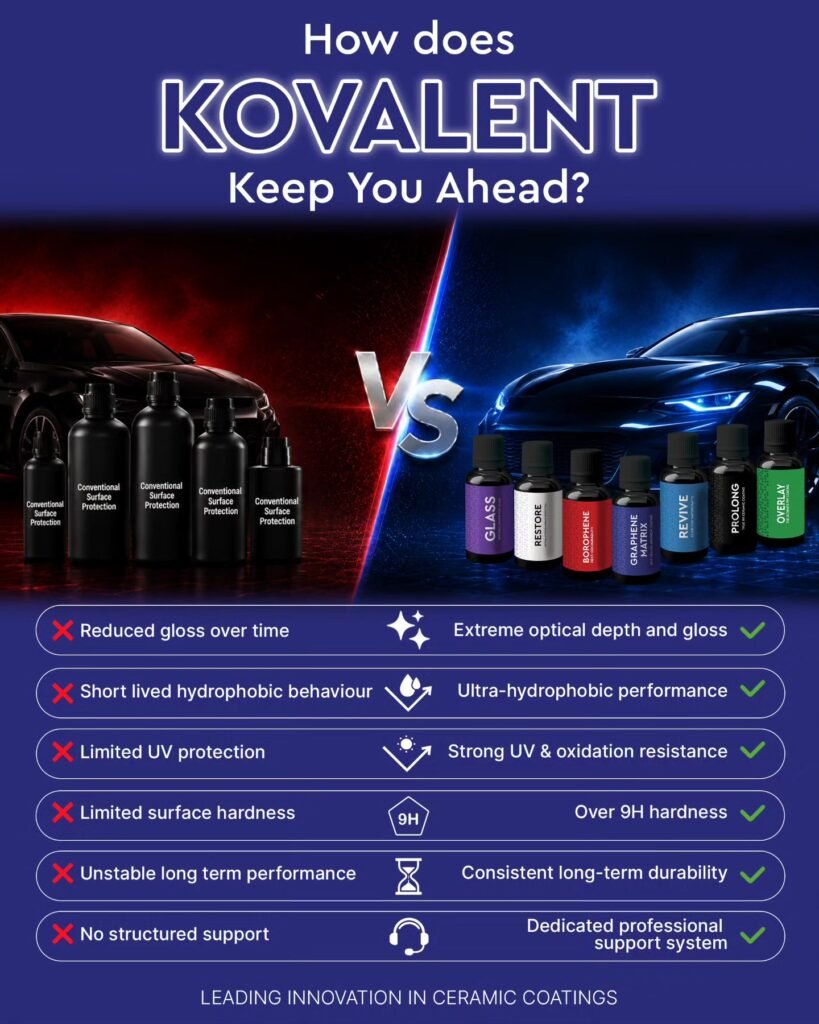
Indian cities present unique environmental hurdles. A professional car ceramic coating addresses these specific issues effectively:
- UV Radiation: The intense sun in cities like Chennai and Hyderabad causes paint oxidation and fading. Ceramic coatings act as a sunblock for your car, reflecting harmful rays.
- Dust and Pollution: In dusty environments like Delhi, particles often stick to the paint. The slick surface of a graphene ceramic coating prevents dust from bonding, allowing it to slide off easily.
- Acid Rain and Pollution: Heavy industrial pollution in Mumbai can cause chemical etching. The chemical resistance of Kovalent Coatings ensures that acidic substances do not reach the clear coat.
- Ease of Cleaning: The hydrophobic nature of the coating means water beads up and rolls off, taking dirt with it. This reduces the time and effort required for routine washing.
Investing in a car ceramic coating is not just about aesthetics; it is about preserving your asset against the unpredictable Indian environment. Kovalent Coatings stands at the forefront of this technology, providing globally recognised, lab-tested solutions specifically engineered for durability.
Whether you choose the reliable 9H silica-based protection or the cutting-edge 10H Graphene Matrix, you ensure your vehicle maintains a showroom finish for years to come. Protect your investment and experience the ultimate ease of maintenance with Kovalent Coatings today.
FAQs
Does ceramic coating prevent all scratches?
It significantly improves scratch resistance against swirl marks and light abrasions, but it does not make the car bulletproof against deep scratches or rock chips.
How long does the application process take?
A professional application usually takes 2 to 3 days, including paint correction and curing time.
Can I apply ceramic coating at home?
Professional-grade products like Kovalent Coatings require controlled environments and expert preparation for the best results.
Does it work on old cars?
Yes, as long as the paint is in good condition. We perform paint correction first to restore the shine, then seal it.
Is ceramic coating better than PPF?
They serve different purposes. Ceramic coating provides gloss and chemical protection, while Paint Protection Film (PPF) offers superior physical impact protection.
How often should I wash a coated car?
We recommend a gentle wash every week or two to maintain the hydrophobic properties.