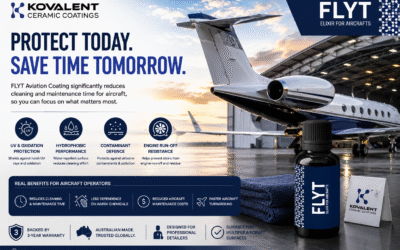
Aircraft operate in environments where UV exposure, oxidation, airborne contaminants, moisture, and engine run-off can place continuous stress on exterior surfaces. An aircraft ceramic coating or advanced aviation surface protection system can provide an additional protective layer while improving hydrophobic performance and simplifying maintenance. Kovalent FLYT is formulated with high-concentration ultra-pure silica nanoparticles and is engineered for private jets, helicopters, and commercial aircraft operating in demanding environmental conditions.
Aircraft paintwork is not exposed to the same conditions as a typical road vehicle. From intense sunlight and high temperatures to changing weather, airborne contaminants and operational residues, aircraft exteriors face a combination of environmental challenges throughout their service life.
This is why aviation paint protection has become an important consideration for aircraft owners, operators, maintenance teams, and professional aviation detailers.
For aircraft operating in regions such as Australia, the USA, the UAE, and Germany, the environmental conditions can vary significantly. A professionally applied protective coating can help maintain surface quality while making regular exterior maintenance more manageable.
What Is Aircraft Ceramic Coating?
An aircraft ceramic coating is an advanced protective coating designed to create a durable surface layer over compatible aircraft exterior materials.
The purpose is not simply to make an aircraft look glossy. A professionally formulated aviation coating can help provide:
- Protection against UV exposure
- Resistance to oxidation
- Protection against airborne contaminants
- Resistance to engine run-off
- Hydrophobic surface performance
- Easier cleaning and maintenance
- Long-term surface preservation
The exact formulation and capabilities vary between products, so aircraft operators should always select a coating specifically developed and approved for the intended application.
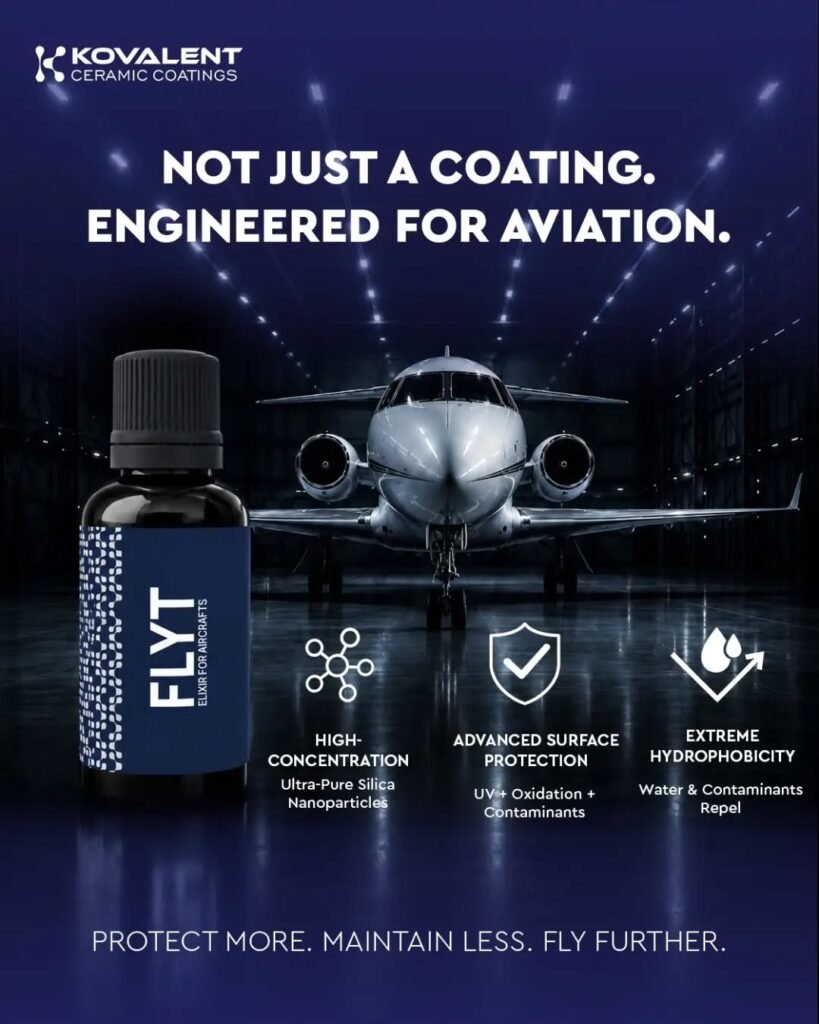
Kovalent FLYT is designed as an advanced aviation surface protection system using high-concentration ultra-pure silica nanoparticles. It is engineered for demanding aviation environments and is designed for private jets, helicopters, and commercial aircraft.
Why Do Aircraft Need Paint Protection?
Aircraft spend considerable time exposed to environmental conditions both during operation and while parked.
Over time, factors such as UV exposure, oxidation, airborne contaminants, and engine run-off can affect the exterior surface and increase maintenance requirements.
A suitable aircraft paint protection system can help create a more resilient surface, reducing the impact of these environmental factors and supporting long-term surface preservation.
It is important to remember that a coating does not replace aircraft maintenance. Instead, it works alongside an appropriate cleaning and maintenance programme.
How Extreme Climates Affect Aircraft Exteriors
Different regions create different challenges for aircraft owners and operators.
Australia: Strong UV and Environmental Exposure
Australia is known for high levels of sunlight and strong UV exposure. Aircraft operating in Australia can also encounter dust, airborne contaminants, coastal conditions, and significant temperature variations depending on their location.
For aircraft regularly exposed to strong sunlight, aircraft UV protection can be an important part of an overall exterior protection strategy.
FLYT is specifically engineered to help protect aircraft surfaces against UV exposure and oxidation while maintaining long-term surface resilience.
UAE: Heat, UV and Desert Conditions
The UAE presents some of the most demanding conditions for maintaining aircraft exteriors.
Aircraft operating in Dubai, Abu Dhabi and other parts of the UAE can experience:
- Intense sunlight
- High temperatures
- Strong UV exposure
- Airborne dust
- Environmental contaminants
These conditions make surface protection and efficient maintenance particularly important.
An advanced coating with hydrophobic characteristics can also help make exterior cleaning more manageable. FLYT is engineered to provide hydrophobic performance while helping protect against UV exposure, oxidation and airborne contaminants.
USA: Diverse Operating Environments
Aircraft in the USA operate across a wide range of climates.
An aircraft may be exposed to intense sun in southern states, cold temperatures and road or runway contaminants in northern regions, or coastal conditions near the Atlantic and Pacific.
Because aircraft can operate across such varied environments, a versatile aviation surface protection system can be valuable for maintaining consistent exterior care.
FLYT is designed to deliver performance across diverse operating environments rather than being limited to a single climate.
Germany: Changing Seasonal Conditions
Aircraft operating in Germany experience changing seasonal conditions, including sunlight, rainfall, moisture, cold weather and airborne environmental contaminants.
Maintaining the exterior throughout these seasonal changes requires consistent cleaning and surface care.
A durable protective coating can complement routine aircraft maintenance by helping preserve the exterior surface and supporting easier cleaning.
How Does Aircraft UV Protection Work?
UV exposure is an important consideration for aircraft exteriors.
Continuous exposure to sunlight can contribute to surface degradation and oxidation over time. This is particularly relevant for aircraft that spend significant periods outdoors.
Aircraft UV protection forms part of the broader protective capabilities of an advanced aviation coating.
FLYT is specifically engineered to help protect against UV exposure and oxidation, supporting long-term surface integrity in demanding environments.
How Does an Aircraft Ceramic Coating Help With Maintenance?
One of the practical benefits of a professional aviation coating is easier ongoing maintenance.
Aircraft exteriors need to be cleaned regularly. Contaminants that adhere strongly to the surface can increase the time and effort required during cleaning.
FLYT enhances hydrophobic behaviour, helping support cleaner surfaces and simplified maintenance routines. The product is also positioned to reduce dependence on harsh cleaning chemicals.
This can be particularly useful for professional aviation detailers and aircraft maintenance teams looking to improve the efficiency of exterior care.
Hydrophobic Protection for Aircraft Surfaces
Hydrophobicity is one of the key characteristics of advanced surface coatings.
A hydrophobic surface has a stronger tendency to repel water rather than allowing it to spread across the surface.
For aircraft maintenance, this can support:
- Easier surface cleaning
- Reduced water retention
- Cleaner-looking exterior surfaces
- Simplified maintenance routines
Kovalent describes FLYT as ultra hydrophobic and ultra slick, with the coating designed to maintain a clean, high-quality finish.
What Does FLYT Protect Aircraft From?
Kovalent FLYT is specifically engineered to help protect aircraft surfaces against several common environmental and operational challenges.
UV Exposure
Helps protect exterior surfaces from the effects of intense UV exposure.
Oxidation
Helps reduce the impact of oxidation on aircraft exterior surfaces.
Airborne Contaminants
Helps protect surfaces against environmental contaminants encountered during aircraft operation and storage.
Engine Run-Off
The formulation is engineered to help protect against engine run-off, supporting long-term exterior surface care.
Together, these capabilities make FLYT suitable for aircraft operating across demanding environments.
Which Aircraft Can Use FLYT?
FLYT is designed for a range of aviation applications, including:
- Private jets
- Helicopters
- Commercial aircraft
The product is also suited to several compatible aircraft exterior surfaces, including:
- Gelcoat
- Painted surfaces
- Clear coat
- Aluminium
This versatility allows professional aviation detailers to use the system across different aircraft surface applications.
Aircraft Ceramic Coating vs Traditional Wax
Wax can provide temporary surface enhancement and water repellency, but advanced aviation coatings are designed for a different purpose.
A professional aviation coating is engineered to create a more durable protective surface and provide long-term performance.
| Feature | Traditional Wax | Advanced Aircraft Coating |
| Surface protection | Temporary | Long-term protection |
| Hydrophobic performance | Yes | Strong hydrophobic performance |
| UV protection | Product dependent | Specifically engineered protection |
| Maintenance support | Limited | Designed to simplify maintenance |
| Durability | Generally shorter | Designed for long-term performance |
| Aviation-specific formulation | Usually no | Available with aviation-specific products |
The right choice depends on the aircraft, surface, operating environment, maintenance programme, and manufacturer’s recommendations.
Why Professional Application Matters
Aircraft coating should not be treated as a simple detailing job.
Proper surface preparation and application are important for achieving the intended performance of any professional coating.
Kovalent positions FLYT for professional detailers and highlights its durability, versatility and ease of application.
A professional application process can help ensure that compatible surfaces are properly prepared and the coating is applied according to the manufacturer’s instructions.
Can Aircraft Paint Protection Reduce Maintenance Costs?
A protective coating cannot eliminate aircraft maintenance, but it can support a more efficient exterior maintenance programme.
Kovalent specifically identifies reduced maintenance costs, faster aircraft turnaround times, and reduced dependence on harsh cleaning chemicals among FLYT’s key attributes.
For aircraft operators, even improvements in routine exterior maintenance can be valuable when aircraft need to be cleaned and prepared efficiently.
Why Choose Kovalent FLYT?
Kovalent FLYT has been developed specifically around the requirements of aviation surface protection.
Key product attributes include:
- High-concentration ultra-pure silica nanoparticles
- Advanced UV and oxidation protection
- Resistance against airborne contaminants
- Protection against engine run-off
- Strong hydrophobic performance
- Ultra-slick surface characteristics
- Long-term surface preservation
- Reduced dependence on harsh cleaning chemicals
- Faster aircraft turnaround times
- Reduced maintenance costs
- 3-year warranty
- Suitability for gelcoat, painted surfaces, clear coat and aluminium
- Australian-made positioning
For professional aviation detailers, aircraft operators and owners looking for aircraft ceramic coating technology, FLYT provides an aviation-focused approach to exterior surface protection.
Frequently Asked Questions
Is ceramic coating suitable for aircraft?
Specialised aviation coatings can be designed for aircraft exterior applications. The product must be suitable for the specific aircraft surface and application. Kovalent FLYT is engineered for private jets, helicopters and commercial aircraft.
What is the best aircraft ceramic coating?
There is no single coating that is best for every aircraft. The right choice depends on the aircraft surface, operating environment, application requirements and maintenance programme. FLYT is specifically formulated for demanding aviation environments and is backed by a 3-year warranty.
Does aircraft ceramic coating protect against UV?
A specialised aviation coating can provide UV protection as part of its overall surface protection system. FLYT is engineered to help protect aircraft surfaces against UV exposure and oxidation.
How long does FLYT last?
FLYT is backed by a 3-year warranty. Actual performance can depend on factors such as application, aircraft usage, environmental exposure and maintenance practices.
Can FLYT be applied to aluminium aircraft surfaces?
Yes. Kovalent lists aluminium among the surfaces for which FLYT is best suited, along with gelcoat, painted surfaces and clear coat.
Final Thoughts
Aircraft operating in extreme climates face continuous environmental exposure. Strong UV radiation, oxidation, airborne contaminants and engine run-off can all contribute to the challenges of maintaining aircraft exteriors.
A professionally formulated aircraft ceramic coating can provide an additional layer of protection while improving hydrophobic performance and supporting easier maintenance.
Kovalent FLYT is engineered specifically for aviation applications, using high-concentration ultra-pure silica nanoparticles to provide durable surface protection for private jets, helicopters and commercial aircraft. With protection against UV exposure, oxidation, airborne contaminants and engine run-off, FLYT is designed to help maintain aircraft surfaces across diverse operating environments.
For professional aircraft owners, operators and aviation detailers in Australia, the USA, the UAE, Germany and other global markets, FLYT offers a dedicated approach to aviation paint protection and long-term aircraft surface care.