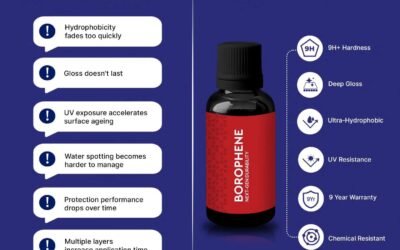
Launching a private label coating brand requires partnering with an established private label ceramic coating manufacturer to handle chemical synthesis, regulatory compliance, bottle filling, and label design. This business model allows detailing supply brands, wholesalers, and entrepreneurs to take custom Borophene, or Graphene formulations to market under their own brand without upfront capital investments in chemical manufacturing infrastructure.
Key Takeaways
In-House Synthesis vs White-Labeling: Partnering directly with a liquid chemistry manufacturer ensures access to custom active resin concentrations, tailored solvent evaporation rates, and batch consistency.
Regulatory & Chemical Compliance: Global distribution requires Safety Data Sheets (SDS), GHS-compliant warning labels, REACH registration, and proper hazardous material shipping classifications.
Low Initial Capital Expenditure: Private labeling eliminates high R&D costs, chemical lab equipment, and raw material procurement hurdles, allowing brands to focus on sales, marketing, and distribution.
Custom Formulation Flexibility: Brands can customize hydrophobic contact angles, cure times, gloss levels, and scratch resistance parameters (9H to 9H+) across automotive, marine, and aviation segments.
Turnkey Packaging Solutions: Complete manufacturing services encompass custom bottle selection, liquid filling, capping, nitrogen flushing, label printing, and master carton packaging.
Understanding the Private Label Ceramic Coating Model
The global surface protection market continues to expand rapidly across automotive detailing, marine maintenance, and industrial surface sectors. However, synthesizing advanced nanomaterials like Silicon Dioxide, Silicon Carbide, Boron Nitride (Borophene), and Graphene oxide requires specialized chemical reactors, raw material sourcing, and strict quality control protocols.
A private label ceramic coating manufacturer bridges the gap between chemical synthesis and brand marketing. Instead of spending millions building a chemical processing plant, business owners can leverage established manufacturing capabilities to bring high-performance detailing products to market quickly and cost-effectively.
White Labeling vs. Custom Private Label Manufacturing
Understanding the distinction between white labeling and true private label manufacturing helps entrepreneurs select the right operational model for their business goals.
1. White Labeling (Off-the-Shelf Formulations)
White labeling involves purchasing pre-formulated, stock ceramic coatings that the manufacturer already produces in volume. The manufacturer simply fills the liquid into bottles and applies your custom label.
Pros: Lowest minimum order quantities (MOQs), faster time to market, minimal initial development costs.
Cons: Identical chemical formulation as other brands using the same stock product, limited performance differentiation.
2. Custom Private Label Manufacturing (Bespoke Formulations)
Custom private labeling involves collaborating directly with chemical engineers to adjust active solid content, solvent carriers, flash times, viscosity, and fragrance profiles.
Pros: Exclusive formulation ownership, distinct market positioning (e.g., fast-flashing mobile installer formula vs long-workability studio formula), higher profit margins.
Cons: Higher minimum order quantities, required sample testing phases, initial formula development fees.
Step-by-Step Process: How to Launch Your Private Label Coating Line
Phase 1: Market & Formula Selection ➔ Phase 2: Testing & Validation ➔ Phase 3: Branding & Packaging ➔ Phase 4: Production & Compliance
Step 1: Define Target Substrates & Market Segment
Identify the primary audience and application scenario for your product line:
Automotive Studios: High solid content, multi-year durability, verified 9H+ hardness, slower flash times for climate-controlled booths.
Mobile Detailers: User-friendly formulas, rapid flash rates, high tolerance for varying ambient temperatures and outdoor humidity levels.
Marine & RV Industry: Heavy-duty gelcoat formulations engineered to withstand salt spray, algae adhesion, and high UV exposure without yellowing.
DIY & Consumer Direct: Lower solid content (30%-50%), aerosol or spray-on ceramic formats, simple wipe-on wipe-off application with forgiving cure windows.
Step 2: Formulate & Sample Testing
Work with your manufacturing partner to test liquid samples under real-world conditions. Evaluate essential performance parameters:
Flash Time: How fast the solvent matrix evaporates after application.
Slickness & Hydrophobicity: Water contact angle measurements (targeting >105° to 115°).
Workability: Ease of wiping off excess residue without creating high spots or micro-marring.
Chemical Resistance: Testing cured panels against acidic (pH 2) and alkaline (pH 13) wash solutions.
Step 3: Select Packaging & Bottle Hardware
Selecting improper bottle hardware can ruin high-grade liquid ceramic formulas. Nanoparticle coatings react to moisture and atmospheric air, making container selection vital:
Glass Bottles: Heavy-wall amber, fluorinated HDPE, or coated aluminum bottles prevent ambient light degradation.
Cap Liners & Seals: Induction foil seals or specialized PTFE (Teflon) cap liners prevent oxygen exposure and solvent evaporation during shipping and storage.
Droppers & Applicators: Provide high-grade dropper caps, pipettes, and microfiber applicator blocks.
Step 4: Label Design & Global Regulatory Compliance
Selling chemical products legally requires compliance with international safety regulations:
GHS Labeling Standards: Including Globally Harmonized System hazard pictograms, signal words (Danger/Warning), hazard statements, and precautionary statements.
Safety Data Sheets (SDS): Professional 16-section SDS documents must be created for every formulation, fully compliant with OSHA (USA), REACH/CLP (Europe), and WorkSafe standards.
UFI Codes: European market distribution requires Unique Formula Identifiers (UFI) registered with the ECHA portal.
Step 5: Batch Production, Nitrogen Flushing, & QC
During bottle filling, high-performance ceramic coatings require nitrogen flushing. Displacing oxygen inside the bottle neck with inert nitrogen gas prevents premature curing before the seal is opened by the end user.
Manufacturing Comparison: In-House vs. Private Label Partner
| Operational Parameter | In-House Chemical Manufacturing | Private Label Manufacturing Partner |
| Capital Expenditure (CapEx) | Extremely High ($1M+ for reactors, mixing labs, filing lines) | Low (Focused solely on inventory and marketing) |
| Time to Market | 18 to 36 Months (Lab setup, trial synthesis, scaling) | 4 to 12 Weeks (Utilizing proven synthesis pathways) |
| Regulatory Burden | Full responsibility for environmental permits, EPA compliance | Handled by Manufacturer (SDS generation, GHS compliance) |
| R&D & Lab Testing | Requires dedicated chemical engineering staff | Turnkey Access to existing R&D labs and chemists |
| Batch Consistency | High risk during initial scaling phases | Guaranteed via strict ISO quality control protocols |
| Profit Margins | Slightly higher per unit at massive volume | High without the ongoing burden of facility overhead |
Crucial Compliance and Safety Considerations
Navigating chemical compliance is essential when distributing liquid protection products globally. Missing regulatory requirements can lead to customs holds, heavy fines, or product recalls.
1. Transport of Dangerous Goods (ADR/DOT/IATA)
Ceramic coatings typically utilize solvent carriers (such as heavy naphtha, siloxanes, or butyl acetate) that fall under hazardous materials classifications for transport. Your manufacturing partner must assist in correctly classifying products under:
UN Number: Proper shipping names (e.g., Flammable Liquids, N.O.S.).
Packing Group: Class II or Class III classifications for air, ocean, and ground freight.
Limited Quantity Exemptions: Packaging configurations that allow retail items to ship without costly hazmat freight surcharges.
2. Environmental & Import Declarations
Importing into regions like the USA, European Union, Australia, or East Asia requires chemical inventory compliance (TSCA in the US, AICIS in Australia, REACH in Europe). A capable private label ceramic coating manufacturer ensures all constituent chemical substances are listed on appropriate national chemical inventories.
Frequently Asked Questions
1. What is the typical Minimum Order Quantity (MOQ) for private label ceramic coatings?
MOQs vary depending on whether you choose off-the-shelf white labeling or custom private label manufacturing. White label orders can start as low as 100 to 500 units per SKU, while custom synthesis formulations generally require 1,000+ units to justify chemical reactor setup.
2. How long is the shelf life of private label ceramic coatings?
Unopened ceramic coating bottles stored in cool, dark environments with proper nitrogen flushing and PTFE cap seals typically maintain a shelf life of 12 to 24 months. Once opened, formulas should be used within 30 days.
3. Can I customize the scent and color of my ceramic coating?
While raw active nanomaterials are clear or translucent, subtle solvent-compatible scents (such as green apple or vanilla) can be integrated into consumer-tier spray products. However, high-solid professional coatings ($SiO_2$/$SiC$/Borophene) usually remain un-fragranced to prevent degrading covalent bonding efficiency.
4. Do I need to supply my own Safety Data Sheets (SDS)?
Established private label manufacturers provide comprehensive, 16-section GHS-compliant SDS documents tailored with your brand name, address, and emergency contact numbers for seamless distribution.
5. What bottle size options are standard for automotive detailing brands?
The industry standard size for professional liquid coatings is 50ml, which provides ample liquid to coat 1 to 2 standard passenger vehicles. DIY spray coatings or maintenance toppers are usually packaged in 250ml or 500ml spray bottles.
6. Can I sell private label marine or aviation coatings under the same brand?
Yes. Many brands offer dedicated product tiers: automotive paint coatings, specialized high-porosity gelcoat formulas for marine hulls, and high-thermal stability formulas for aviation paintwork.
Partner with Kovalent Coatings for Private Label Manufacturing
Ready to launch or scale your own brand of professional surface protection products? Kovalent Coatings brings in-house Australian chemical synthesis, rigorous testing, and complete turnkey private labeling capabilities to help you grow your brand.
From custom Sio2, Borophene, and Graphene matrix development to bottle selection, GHS-compliant labeling, and international logistics, we handle the manufacturing complexity so you can focus on expanding your business.
Contact our business development team today to request wholesale samples, discuss formulation capabilities, and start your private label journey.